AltEnergyStation.com

This blog is for the discussion of alternative energy and the altenergystation.com web site. Please feel free to add posts and comments.

Saturday, March 8, 2008

Diesel Hybrid 69 MPG

Exciting News. 69 mpg for a diesel hybrid car. The article attempts to make a point that consumers would be unwilling to pay the extra $$ for a diesel hybrid vehicle. With gasoline prices continuing to increase... soon to be $4 plus per gallon. I'm not so sure that would be the case.

If you could double or even triple your fuel economy.... perhaps it will make sense to some consumers.... depending on their driving behavior. There are also some of us out there that would pay a premium in order to help the environment and reduce our reliance on foreign oil.

To learn how diesel hybrid vehicles work, go to http://altenergystation.com/Hybrid-Electric_Vehicles.html , while this is a description of a gasoline hybrid, the concept is very similar.


CNNMoney.com 3/7/08


Better mileage than a Prius? Not so fast

VW's new diesel-powered hybrid gets great mileage - better than Toyota's top-selling hybrid. Its price-tag is another story.

NEW YORK (CNNMoney.com) -- It was bound to happen - the Toyota Prius could soon lose its crown as the most fuel-efficient car on the market. But you might want to hold off before you cancel your order.

The VW Golf TDI Hybrid gets 69 miles per gallon in the European fuel economy test cycle, according to Volkswagen. Toyota claims 54 mpg for the Prius in the same test.

Volkswagen unveiled a Golf hatchback in Europe this week that gets even better mileage than the Prius. It's a concept vehicle for now, but the diesel-powered hybrid indicates something that's in the "near term future" for European customers, a VW spokesman said.

Customers in the U.S. would have to wait a little longer, but a car like this could eventually be sold here, said Keith Price, a spokesman for Volkswagen of America.

Check under the hood

It's easy to understand why the Golf gets 26% better mileage than a Prius, which burns gasoline. The Golf TDI hybrid has a diesel engine, which is more efficient.

A non-hybrid 2006 Volkswagen Jetta diesel sedan gets 33 mpg in combined city and highway driving, according to current EPA estimates. A 2007 Toyota Camry Hybrid, a similarly-sized car, gets just one mile per gallon more. And the Jetta diesel gets much better highway fuel economy - 38 mpg - than the Camry Hybrid's 34 mpg.

You may wonder why no one thought of the diesel/hybrid combination before.

"From a consumer standpoint, it comes down to 'What kind of compromise do I need to live with to enjoy all this wonderfulness?'" said VW's Price. And the biggest challenge, he conceded, is cost.

And then check your wallet

Diesel engines burn fuel using high pressure and heat instead of a spark. The engines have to be more rugged to withstand the strain, so they're more expensive to build.

Chrysler has a small test-fleet of plug-in diesel hybrid Dodge Sprinter vans in commercial use today, but the technology is too pricey to put into passenger vehicles, said Chrysler spokesman Nick Cappa.

"There has to be a customer value there," he said. "It has to pay for itself."

For the U.S. passenger car market, there's an additional cost hurdle: It's harder for diesel engines to meet strict clean-air requirements here. They produce lots of noxious fumes and particles that require expensive exhaust treatment systems.

But with new ultra-clean diesel fuel now readily available at American gas stations and new exhaust-cleaning technology in cars, various automakers hope to introduce a new generation of clean-diesel cars here over the next couple of years.

But like hybrids, these new diesels will be more expensive than similar gas-powered cars. The mark-up may not be quite as much, though.

Volkswagen estimates that the 2009 Jetta diesel will cost about $2,000 more than the gas-powered version. Official pricing hasn't been announced yet, though. (The 2006 model year was the last time VW sold diesel cars in the U.S.)

Manufacturers almost always add unrelated equipment to hybrids, so it's difficult to estimate a cost, but hybrids usually cost at least $2,500 more than non-hybrid versions of the same vehicle.

Add those numbers altogether, and a hybrid diesel would be dauntingly expensive, even if federal tax incentives were factored in.

Buyers could also lose another big cost benefit: excellent resale value. Diesel engines last longer than gas engines so diesel cars are worth more after years of driving.

Hybrids, on other hand, generally do worse than other cars in resale value, according to Kelley Blue Book. Combine a hybrid and a diesel, and its resale value is anybody's guess, said Robyn Eckard, a Kelley Blue Book spokeswoman.

On its way to the U.S.A.

For now, the Golf TDI Hybrid comes closest to making sense in Europe. Diesel fuel generally costs less than gas there, adding to the financial benefit of greater fuel efficiency. And European regulations don't require all the pricey emission-cleaning technology needed to sell diesels in the U.S. That's why diesels make up about half of new car sales in Europe.

Technology costs will come down over time, though, points out VW's Price. "The costs of all technologies come down with acceptance," he said.

If a diesel hybrid is a hit in Europe, and VW were to ramp up production, that could bring down the per-unit costs, he said. And that could open the door to selling such a car in the United States.

By that time, U.S. consumers should be familiar with VW's - and other companies' - new diesels, said Price.

And if any company could make it work in the United States, it would be VW, said Charlie Vogelheim, vice president of J.D. Power and Associates.

Even though they're not currently sold here, VW's diesels still have a strong cult following, he said: "It's like 'I don't care what anyone else thinks, I love my diesel car."

Labels: , ,

Sunday, August 26, 2007

Diesel-like gasoline engines - 15% higher Fuel Economy

Another reason to celebrate. 15% better fuel economy from gasoline engines. While the article doesn't indicate it, I hope that this new technology will enable ethanol fuel cars to also get the increased fuel economy.

American auto companies... are only just now 'getting it'. American drivers want fuel efficient cars,they don't want to expend such a large portion of their wallet on energy.

GM unveils diesel-like gasoline engines

Drivable concept versions of General Motors cars that use efficient new engines with HCCI technology revealed Friday.


NEW YORK (CNNMoney.com) -- General Motors revealed two drivable concept cars with new engines that burn gasoline in virtually the same way that a diesel engine burns diesel fuel.

The engines will get 15-percent better fuel economy than ordinary gasoline engines, GM estimates, but will not need the expensive exhaust treatment that diesel engines require.

2007_saturn_aura.03.jpg
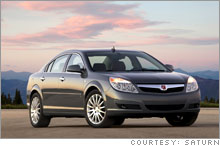
GM is revealing the fuel saving diesel-like gasoline engine in a version of the Saturn Aura.

Several car companies have been working on this type of engine technology, commonly known as homogeneous charge compression ignition, or HCCI. The technology promises the fuel economy of a diesel engine, which is typically much more efficient than a gasoline engine, but with the much cleaner exhaust of a gasoline engine.

In an HCCI engine, gasoline is ignited inside the cylinder using compression and the engine's own heat without the need of a spark. This is the same way that a diesel engine ignites diesel fuel. (When the engine is first started, and until it warms up, GM's HCCI engine still uses a spark to ignite the fuel.)

This type of ignition results in more energy to propel the vehicle because the fuel burns with less heat and light, which wastes energy, and because there is more compression when the fuel is ignited and, therefore, more of a push when the fuel and air expand.

"I remember debating the limits of combustion capability when I was in college," Tom Stephens, group vice president, GM Powertrain and Quality, said in a company statement. "HCCI was just a dream then. Today, using math-based predictive analysis and other tools, we are beginning to see how we can make this technology real."

The vehicles GM showed Friday are a Saturn Aura and an Opel Vectra, two virtually identical mid-sized sedans, both equipped with 180-horsepower 2.2-liter four cylinder HCCI engines.

They can drive at up to roughly 55 miles per hour using diesel-like ignition but will have to rely on traditional spark ignition at higher speeds or under heavy loads, GM said.

"Perhaps the biggest challenge of HCCI is controlling the combustion process," said Dr. Uwe Grebe, executive director for GM Powertrain Advanced Engineering.

Engineers hope to increase operating range under HCCI and improve performance under cold weather and high-altitude conditions, the company said. Top of page


Labels: