AltEnergyStation.com

This blog is for the discussion of alternative energy and the altenergystation.com web site. Please feel free to add posts and comments.

Sunday, August 26, 2007

Diesel-like gasoline engines - 15% higher Fuel Economy

Another reason to celebrate. 15% better fuel economy from gasoline engines. While the article doesn't indicate it, I hope that this new technology will enable ethanol fuel cars to also get the increased fuel economy.

American auto companies... are only just now 'getting it'. American drivers want fuel efficient cars,they don't want to expend such a large portion of their wallet on energy.

GM unveils diesel-like gasoline engines

Drivable concept versions of General Motors cars that use efficient new engines with HCCI technology revealed Friday.


NEW YORK (CNNMoney.com) -- General Motors revealed two drivable concept cars with new engines that burn gasoline in virtually the same way that a diesel engine burns diesel fuel.

The engines will get 15-percent better fuel economy than ordinary gasoline engines, GM estimates, but will not need the expensive exhaust treatment that diesel engines require.

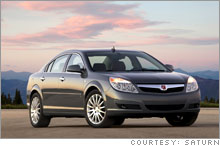
2007_saturn_aura.03.jpg
GM is revealing the fuel saving diesel-like gasoline engine in a version of the Saturn Aura.

Several car companies have been working on this type of engine technology, commonly known as homogeneous charge compression ignition, or HCCI. The technology promises the fuel economy of a diesel engine, which is typically much more efficient than a gasoline engine, but with the much cleaner exhaust of a gasoline engine.

In an HCCI engine, gasoline is ignited inside the cylinder using compression and the engine's own heat without the need of a spark. This is the same way that a diesel engine ignites diesel fuel. (When the engine is first started, and until it warms up, GM's HCCI engine still uses a spark to ignite the fuel.)

This type of ignition results in more energy to propel the vehicle because the fuel burns with less heat and light, which wastes energy, and because there is more compression when the fuel is ignited and, therefore, more of a push when the fuel and air expand.

"I remember debating the limits of combustion capability when I was in college," Tom Stephens, group vice president, GM Powertrain and Quality, said in a company statement. "HCCI was just a dream then. Today, using math-based predictive analysis and other tools, we are beginning to see how we can make this technology real."

The vehicles GM showed Friday are a Saturn Aura and an Opel Vectra, two virtually identical mid-sized sedans, both equipped with 180-horsepower 2.2-liter four cylinder HCCI engines.

They can drive at up to roughly 55 miles per hour using diesel-like ignition but will have to rely on traditional spark ignition at higher speeds or under heavy loads, GM said.

"Perhaps the biggest challenge of HCCI is controlling the combustion process," said Dr. Uwe Grebe, executive director for GM Powertrain Advanced Engineering.

Engineers hope to increase operating range under HCCI and improve performance under cold weather and high-altitude conditions, the company said. Top of page


Labels:

Thursday, August 23, 2007

Federal Renewable Power Targets....

This is great news and hopefully the House and Senate will pass this legislation and the President signs it. It would be a landmark piece of legislation.


It is a small target, having the utilities get 15% of their power from renewable sources by 2020. An achievable target. What I find interesting is that no one is saying its a technical impossibility. The argument are all about costs. What I believe we should be asking ourselves is 'what is the cost of not doing this'. In a previous post I pointed out that Europe was ahead of the US on this. They have targets in place now.


We all need to support these targets. ----

Today I posted information on Net Metering to the Altenergystation.com web site. Net Metering are state policies on how consumers and businesses can add their excess renewable energy generation into the power grid. Consumer electric generation can help the utility companies achieve these achievable targets.


Renewable power hits your wallet

Most experts say utility bills will go up, but not by much, if a provision in the House energy bill becomes law.

By Steve Hargreaves, CNNMoney.com staff writer

NEW YORK (CNNMoney.com) -- If a bill that recently passed the House of Representatives becomes law, soon every American would have to pay a little extra for renewable power each month in their utility bill.

The house bill would require most utilities to get 15 percent of their power from renewable resources by 2020.

CNNMoney's Steve Hargreaves sits down with Philips North America CEO, Paul Zeven, to discuss how the company plans to help reduce energy use worldwide, by simply changing a light bulb.
Play video

Anecdotal evidence from one utility says some Americans, about 20 percent, are willing to pay about 8 percent more for this power. Yet when given the option, only about 5 percent of people actually sign up.

So are people in for a big shock if the bill becomes law? The answer varies depending on who's asked.

"We're very concerned about the rate impact our customers are going to see when this mandate hits them in the pocket book," said Stan Wise, a commissioner with the Georgia Public Utilities Commission.

But like most experts in the energy field, he couldn't put a dollar amount on what the House bill might cost consumers if it became law.

Obviously, the cost to consumers will vary depending on the abundance of renewable resources in each region.

Wise, like many commissioners from Southeastern states, opposes a federal renewable requirement on the grounds that it unfairly hits Southeastern states, which he says do not have an abundance of wind resources. Wind is one of the cheapest ways of generating large amounts of renewable power.

But proponents of the bill, who argue its needed to foster investment in renewable power and move the country away from a reliance on fossil fuels, say the Southeast could buy the power from other areas, or simply pay a fee to subsidize renewable power in other regions, thereby "offsetting" their own emissions of carbon dioxide, a leading greenhouse gas.

About half the states currently have a law requiring the purchase of renewable power, and North Carolina's may provide some insight on just how much it's expected to cost. The state recently required its utilities to get 12.5 percent of their power from renewable sources by 2021, a less ambitious plan than the one offered in the House.

North Carolina's law also caps the amount that customers can be charged for the renewable power. In 2008, the cap is $10 per year, increasing to $34 per year by 2015.

On an $80 a month electric bill, the average in the state, that's about a 3.5 percent increase by 2015.

"As a percentage of their bill, it's not a big hit," said Tom Williams, a spokesman for Duke Energy (Charts, Fortune 500), the state's big utility. Still, whether the state can achieve even its modest goal with such a small rate increase is yet to be seen.

Others in the industry think a renewable power law will actually decrease prices in the long run.

Hitting the House's 15 percent by 2020 proposal will require a nationwide investment of $134 billion, according to a recent study by the energy consultants Wood Mackenzie.

But renewable power would take some of the pressure off the demand for natural gas, currently used to generate about 20 percent of the nation's power and eyed as a big source for future generation needs.

The reduced demand for natural gas should lower its price, and Mackenzie estimates the savings could be as much as $240 billion by 2026.

"Over the long run, there is a net benefit to it," said William Durbin, head of global gas and power research at Mackenzie.

In the short run, Durbin said the up front investment to build the renewable power would cost consumers.

He couldn't say how much more people could expect to pay, but said it's likely to be closer to 5 or 10 percent rather than, say, 50 percent.

Others don't agree with the Mackenzie study.

"I think [the bill] would increase the cost," said Michael Allman, president of Sempra Generation, although he said there were too many other variables to predict exactly by how much.

Sempra Generation, a unit of California-based Sempra Energy (Charts, Fortune 500), runs four natural gas power plants in the Southwest.

Allman's argument implies that if natural gas prices really did spike, people would build more renewable capacity without a mandate from the federal government.

"When you constrain something, it has never been good," he said.

The House bill is set to be conferenced this fall with a Senate version, where a renewable energy mandate failed earlier this year. Top of page

Labels:

Wednesday, August 22, 2007

Georgia goes Ethanol...

I believe it is great that ethanol is being developed across the nation. Below you will see some of my comments on this article... I am particularly excited about ethanol since it can be used in gasoline engines/cars with the use of an ethanol converter... which only costs $300 ... now... but as more people use, i'm certain the cost will decline.

I know that ethanol isn't perfect... but the fact that we can convert millions of cars on the road today... I believe is a good thing. Check out altenergystation.com and you can find a link to a site where you can buy an ethanol converter.


Midwest, move over: Ga. joins the ethanol gold rush

Antawon Randall fills up a 2007 Chevrolet Impala with E85 flex-fuel at the Cheveron station in Washington, D.C.
By Chip Somodevilla, Getty Images
Antawon Randall fills up a 2007 Chevrolet Impala with E85 flex-fuel at the Cheveron station in Washington, D.C.
TIFTON, Ga. — Looking out at a mound of tree tops, limbs and leaves just discarded from a harvest of 45-foot high pines, Devon Dartnell sees fuel, lots of it, to run Georgia's 8 million vehicles.

"See this?" he asks, pointing to rotted trees and scattered underbrush on a 300-acre tree farm. "This is very usable for biofuels."

Dartnell, the biomass program manager for Georgia's Forestry Commission, is thinking about one fuel in particular: ethanol.

With its 25 million acres of forest second only to Oregon, Georgia is setting itself up to lead the ethanol revolution. The state not only wants to produce and sell corn ethanol, which until recently has been confined to Midwestern corn-growing states, it wants to lead the way for cellulosic ethanol, which is made from organic matter such as trees, plants, peanut shells and sugar cane.

Amid concerns over high oil prices and the environmental impact of fossil fuels, Georgia is among a handful of states outside the Corn Belt that are joining the gold rush for ethanol, an alcohol fuel that many hope can lessen the country's dependency on gasoline.

Backed by federal subsidies for producing and selling ethanol, the states are adding their own incentives to attract ethanol producers and convince retailers to install pumps selling the alternative fuel.

New York offers a 15-cents-per-gallon tax credit for producers of biofuels, including E85, after they produce their first 40,000 gallons. Georgia has tax credits for equipment and expedites permits and other paperwork. Next year, South Carolina will return to drivers the first $300 they spend on E85.

More gas stations beginning to offer it

The number of gas stations offering E85, a blend of 85% ethanol and 15% gasoline, has almost tripled in the past two years to nearly 1,200. The market, though, is still less than 1% of the nation's 170,000 gas stations.

Colorado has 29 stations with E85 pumps and expects to see another 21 open by the end of the year. New York just opened two retail E85 pumps. South Carolina, with 37, has the most outside the Midwest.

Several, including Texas, California and Georgia, are attracting corn and cellulosic ethanol producers.

Louisiana is opening its first cellulosic ethanol plant, which by 2010 is expected to produce about 20 million gallons of ethanol a year from the pulp left over after sugar is extracted from the cane.

"All the stars are lining up," says Michael Olivier, Louisiana's economic development secretary. "It's an evolution. … In the long term, those states that are engaged in the biodiesel, biomass energy process, they will be the winners."

Last year, the United States produced almost 6 billion gallons of ethanol, according to the Renewable Fuels Association. Construction of another 77 plants is expected to double production by next year, says Bob Dinneen, the association's president.

Georgia wants to lead the pack. It is launching a dizzying number of projects to eventually help the state produce about a quarter of the fuel used by its residents, says Jill Stuckey, the director of alternative fuels.

Before Katrina hit two years ago and threatened Georgia's oil pipelines and gas supplies, Stuckey was a bit like the Maytag repairman; there wasn't much buzz around her work. After Katrina, "Suddenly I was popular," she says.

Stuckey traverses the state for locations to entice biofuel companies, which make fuel derived from organic matter, to invest in Georgia. One of her big catches is Range Fuels, a Colorado company that plans to open a plant next year in southern Georgia that will make 20 million gallons of ethanol a year using the state's vast timber inventory.

Right now, Georgia has only one ethanol producer, in Baconton, where Wind Gap Farms has been churning out about 500,000 gallons a year for two decades. Ethanol is a byproduct of its primary business, drying yeast from beer waste that it sells to make pet food.

For years, the company couldn't give the ethanol away, says manager Des Stewart. "The market is growing," he says. "Two years ago all our alcohol went out of Georgia, but it is now all sold here."

As they begin to see more ethanol at the pump, motorists are trying to figure out what to make of it.

In Georgia, Tesha Moore of Atlanta fills up a 2007 Chrysler Aspen at one of the three stations in the state that offers E85. "I don't know anything at all about it, but it's cheaper," she says. "We'll see how it does."

E85, though, has a long way to go.

Only 6 million cars, called "flex-fuel," can run on ethanol or gasoline. Car companies have pledged to make half their fleet flex-fuel by 2012. Also, E85, on average, costs 13% less per gallon than gasoline, but it reduces mileage by as much as 25%.

Concerns about energy use, air pollution

The speed with which Georgia and other states are moving to produce and sell ethanol worries some environmentalists and air-quality activists, who are concerned about the fuel's impact on air pollution and the amount of energy it takes to produce ethanol, particularly corn ethanol.

Debate swirls around conflicting studies that show ethanol reduces carbon emissions that produce greenhouse gases but increases nitrogen oxide and volatile organic gases that contribute to smog.

One study, by Argonne National Laboratory, a research arm of the Energy Department, found that corn ethanol can reduce greenhouse gas emissions from cars by 18% to 29% and cellulosic ethanol can reduce emissions by up to 86%. However, a study at Stanford University found that ethanol was unlikely to improve air quality and that if all cars ran on ethanol by 2020, there would be an increase in certain air pollutants, such as acetaldehyde and formaldehyde, that would cause a rise in asthma and other respiratory illnesses.

A study at Cornell University that questions ethanol's environment-friendly halo found that corn ethanol takes up to 40% more energy to produce than it provides as a fuel.

"Biomass in general will not provide us with all the fuel we need," says David Pimentel, an agriculture professor who wrote the Cornell study. "I don't think it will be the savior we've been hearing about."


User Image
morefice wrote: <1m>
To reduce our dependence on oil... we need to try everything... allow everything to develop...hyrdrogen, ethanol, biodiesel, electric, natural gas... etc. We have used gasoline autos for close to 100 years now. To make a dramatic change we need to support the development of numerous technologies.

I am particularly excited about ethanol, because its a fuel that EXISTING gasoline cars and trucks can use with an ethanol converter. For most cars it costs about $300. We have a large base of cars on the road. We need to address new cars as well as existing cars on the road. Ethanol does that. The web site, www.altenergystation.com has a link to purchase an ethanol converter... as well as a link to a locator so you can find the ethanol station closest to you... check it out.... www.altenergystation.com

Labels:

Nissan Adds 'fuel-efficiency' Meter.....

This is a great feature being added by Nissan to all models.... see my comments below... one of my biggest frustrations is why is a foreign automaker leading the way... why are American Auto makers following.... We must abandon our past and more aggressively forward to grow alternative and renewable fuel cars and trucks and in the mean time... make every effort to make cars that are more fuel efficient and empower drivers to use less when they drive.


Nissan to put lead-foot gauge on all models
Nissan's fuel-efficiency meters (like this one below the speedometer) will allow drivers to see the effect of a lead foot.
Nissan
Nissan's fuel-efficiency meters (like this one below the speedometer) will allow drivers to see the effect of a lead foot.
Nissan (NSANY) plans to equip all of its cars and trucks with a gauge to tell drivers when they are being gas-guzzling lead foots.

The "fuel-efficiency" meter, as the gauge is called, shows up already as a horizontal bar in the instrument cluster of the 2007 Nissan Altima and the 2008 Titan pickup, Armada SUV, Infiniti G35 car and QX56 SUV. When coasting down a hill, the meter is long and orange, meaning little fuel is being used. When the pedal is to the metal, the line shortens dramatically.

"You will become a little less lead-footed if you can see what putting your foot to the pedal does to your fuel economy," suggests Nissan spokesman Tony Pearson.

Similar gauges are found on some models by other automakers, especially hybrid and luxury vehicles. But Nissan's move to put them on every model demonstrates how automakers are racing to be fuel conscious as high gasoline prices weigh more heavily on consumers.

Based on in-house tests, Nissan predicts drivers will cut their fuel use by about 10% when they have a gauge that monitors their driving habits. The gauge will be phased in as new models roll out over the next few years.

Environmentalists are encouraged.

"It shouldn't be just wealthy people with luxury cars that have this information," says Tim Carmichael, senior director of policy for the Coalition for Clean Air. "I hope the rest of the industry follows them."

David Friedman, research director for the vehicles program of the Union for Concerned Scientists, says Nissan is making a "common-sense thing that should have been done decades ago so you know what you're getting" when it comes to fuel mileage.

Ford Motor (F) and General Motors (GM) combine their gas-mileage information in a "driver information center" that not only shows gas use at the moment but over the length of a trip. On Ford's Mustang and its pickups, the feature comes as part of optional, higher-cost trim levels.

Toyota's (TM) readout on vehicles such as Prius, Avalon, Camry and Highlander goes all the way to 99 miles per gallon.

Honda (HMC) has a gauge on its hybrids, but in addition, it has a simplified "eco light" on some gas-powered models, including Odyssey minivan, Pilot SUV and Accord sedan. It lights when the vehicle is being driven at its optimum. "Our customers tell us it's a helpful tool," says Honda's Sage Marie.

Some automakers worry that the gauge could add another layer of distraction to the dashboard. "We're already putting in so many features for the driver," says Chrysler spokesman Nick Cappa. Chrysler will have the gauges on its new hybrid models.


morefice wrote:
I think this is a excellent auto feature. I hope that all world automakers begin to add this to all new cars. I would also like to see a retrofit device created for all existing autos. If given a choice, consumers will use less fuel..they will modify their driving behavior to save fuel, especially it just requires them to drive differently....not less.

Check out the web site http://www.altenergystation.com for information on alternative and renewable fuel cars and trucks. Its the direction we need to move towards...but until that time ... everything we can do to use less gas should be supported.

A side benefit of this also might be fewer auto accidents and fewer fatalities.

Labels:

Tuesday, August 21, 2007

Slowing Demand for Gas....

It appears that the growth is slowing. This is great news...if its true. A statistic below is extremely interesting. Gas sales represent 3% of the nations economic activity. Wow. This really is significant when you consider that many forces influences the price we pay for gas.

Kicking the gas habit

Demand growth is slowing, not long after prices hit a record $3.23 a gallon, but it may be too early to call it a trend.

By Steve Hargreaves, CNNMoney.com staff writer

NEW YORK (CNNMoney.com) -- American motorists may have finally eased up on the gasoline habit.

After years of strong demand despite record high prices, there's evidence that the rate of growth in gas consumption is easing. Whether last spring's spike above $3 made a difference, the recent credit worries have crimped demand, or if the decline is merely a statistical blip remains to be seen.

Video More video
CNN's Matthew Chance explores Kazakhstan.
Play video

ut one fact is clear. Demand for gasoline in the United States grew just 0.4 percent in the latest four weeks from a year earlier, according to the Energy information Administration, which polls refineries and wholesalers to gauge the amount of fuel sent to filling stations, down from 1.4 percent growth just five weeks earlier.

The average rate of growth over the last decade or so is about 1.5 percent, according to the federal agency.

The American Petroleum Institute, an industry organization that also uses refining and wholesale numbers, said demand grew 0.6 percent in July from a year earlier, compared to 1.3 percent in May and a whopping 3.7 percent in June.

And MasterCard SpendingPulse, a research unit at the credit card company that estimates demand at the pump based on credit card purchases, said gasoline demand grew at a rate of 1.6 percent last week, down from growth of 4.3 percent six weeks ago.

While the trend seems fairly clear, experts gave a variety of reasons why demand growth may be cooling.

A drop in demand growth could mean cheaper prices at the pump, as traders have long cited strong demand in the U.S. as a main reason for high oil and gas prices.

Gas prices are of course closely watched by everyone who drives. But they also are a key part of the economy: At $3 a gallon, gasoline sales account for about 3 percent of the nation's total economic activity.

While average gasoline prices peaked at an all-time recorded of $3.227 a gallon back in May, according to AAA, at Tuesday's average of $2.78 they are still historically high.

The high prices could finally be curbing demand.

"People drove less because they thought they were having their collective pants taken down by the oil companies," said Tom Kloza, chief oil analyst at the research group Oil Price Information Service.

But like others, Kloza said to not put too much stock in the numbers.

"We just see fluctuations from week to week, I'm not ready to call it a trend yet," said Ron Planting, an economist at American Petroleum Institute.

Planting noted that despite the recent slowdown in growth, demand is still up about 1.6 percent so far this year, up slightly from the previous two years.

Michael McNamara, director of research for MasterCard SpendingPulse, said the drop in demand growth is consistent with a slowdown in retail spending and the slowdown in the economy this year.

As for high prices curbing demand, "It has an effect, but I don't think there is one magic number," said McNamara.

At EIA, senior oil market analyst Doug MacIntyre said the demand growth numbers may appear small because last year demand was so high.

Also, MacIntyre said, the last month has seen either very hot or very wet weather across many parts of the country, and that may have kept people from driving more.

Regarding whether high prices are convincing people to stay at home more, MacIntyre said "It's certainly something worth watching, but I'm not ready to say it's a big factor just yet." Top of page

Labels:

Sunday, August 19, 2007

Advances in Solar Cells

There continues to be many advances in solar cells... article below talks about how solar cells are being designed to look and act like roof shingles. Hopefully one day... roofing material will include a solar energy component.


Latest Solar Cells Look Like Regular Roof Shingles

Friday, June 22, 2007


For instance, the National Institute of Standards and Technology has been testing various forms of photovoltaic roofing products for the past year on roofs in Maryland to calibrate their output.

Brian Dougherty, project manager, said the test includes tile (popular in the Southwest), slate (popular in Europe) and shingle (popular everywhere). All of them have inactive areas where the roofer can drive nails and not short out any circuits.The result of the NIST test, expected later this year, will be a technical report on the underlying technologies rather than a buyer's guide to brand names, Dougherty said.

Tired of your roof just soaking up rays and not pulling its load? You're not alone.

Increasing numbers of people are putting their roofs to work generating electricity. And that does not necessarily mean installing unsightly steel-and-glass solar energy modules.

Today you can get photovoltaic shingles (or tile, or slate) that will do the job and still look like a roof.

But he said that efficiency ranges from 6 percent of the incoming solar power being converted to electricity, to about 16 percent.

"Shingles are just getting started — most of the market is still roof-mounted modules," cautioned Paul Maycock, president of Photovoltaic Energy Systems Inc. in Williamsburg, VA.

And he was not sure that the situation would ever change dramatically, since most existing roofs were not designed with solar energy in mind.

Working roofs

"You look for a south-facing roof that is not shadowed by trees or by another building, and you cover it as best you can," Maycock said. Solar energy modules can be mount on racks on the roof to catch the sun to best advantage, although the results may be quite unsightly.

"With shingles, you are stuck with the roof you have, and with the less-desirable results that it gives you. So in many cases you just don't do it," Maycock said.

So it's no surprise that most of the photovoltaic (PV) roofs are in new upscale residential construction in the sunny Southwest, where the cost of a PV roof (about $14,000 for 2 kilowatts of capacity, according to Maycock's figures) would fit in the mortgage's round-off error.

Taxes and power

Additionally, California and New Jersey offer tax credits that actually make solar power economically sensible, Maycock added. (Other states offer less juicy tax credits, and the Federal taxman offers one that caps out at $2,000.)

Maycock figures that the cost of electricity from a PV roof is about 40 cents per kilowatt hour, but that tax credits can reduce that figure to 20 cents.

The national average for utility power is 12 cents, but the price ranges between 16 and 21 cents in California, and as high as 24 cents in parts of New York State, he said.

To make PV roofing pay, the local utility must also offer "net metering" meaning that your power meter can run backward while your roof is sending excess power to the grid, reducing your bill.

(Even with a south-facing PV roof, 70 to 80 percent of an average home's power will still have to come from the utility company.)

Net metering is available in about 20 states, Maycock noted.

Copyright © 2007 Imaginova Corp. All Rights Reserved. This material may not be published, broadcast, rewritten or redistributed.

Labels:

Thursday, August 16, 2007

Political Cartoon - - - Irony and Middle East Oil

A blog reader asked me to post this political cartoon.

I believe it reflects an important message. As Americans, in general, we want big cars, that use lots of gas, and we want to drive all the time, everywhere. Yet in doing so we are NOT supporting our troops, we are empowering the brutal political factions and regimes....and allowing them to influence...manipulate and essentially have control over our lives.

Its for this reason, we all need to use and support the movement away from oil towards renewable and alternative fuels.
if (document.all &&amp;amp; document.getElementById) { navRoot = document.getElementById("piNav"); for (i=0; i

Labels:

Wednesday, August 15, 2007

Cellulosic Ethanol Plant Opening in California... ..

The article below is very big news... while there is expected to be consolidation in the ethanol industry that should be expected since it in its infancy stage as an industry.

The bigger news is the opening of a Cellulosic Refinery in Southern California. One of the first. Low cost to make and abundant raw materials. Very good news to the alternative/renewable fuel movement. I am keeping my eyes on Bluefire....


Big ethanol shakeout coming?

As the U.S. tries to free itself from Big Oil's grip, larger biofuel producers look to stake their claim in a growing business.

By Jeff Cox, CNNMoney.com contributing writer

NEW YORK (CNNMoney.com) -- Get ready: It may still be a fairly new industry, but there's probably a big shakeout brewing in the fast-growing ethanol business.

The rising cost of raw materials and demand for newer and better technology has Big Ethanol poised to take control of the $23 billion biofuel industry.

CNN's Candy Crowley reports about a big win for big oil and seersucker suits making a comeback on capitol hill.
Play video

In the decades since corn ethanol production began in the United States, a small army of plants has popped up across the national landscape. Most produce around 50 million gallons a year or less, and have survived in Midwest markets where corn is plentiful and demand for flex-fuels sufficient.

But as the industry evolves, corn prices climb and the nation gets much more aggressive in developing biofuels, smaller plants that rely on dated technology stand less of a chance of surviving.

In fact, some operators of plants on the low end of the production scale are already getting jittery about what will happen to them if corn continues to linger around $4 a bushel and the cost to transport ethanol stays high.

"They have every reason to be nervous," said Peter Gray, head of the energy and natural resources division at KPMG Corporate Finance, the investment banking arm of KPMG. "Ethanol is part of the solution in the U.S. and part of the problem. What we've had here is massive overbuild."

Gray predicts widespread consolidation in the industry as the nation moves toward its goal of producing 36 billion gallons of ethanol by 2022, nearly half of which must come from corn. As for which plants will survive, Gray pointed to plants that produce at least 100 million gallons a year as a line of demarcation for sustainability.

Some 124 U.S. ethanol plants now produce about 6.5 billion gallons a year, an average of about 52 million gallons per plant. Capacity ranges from mega producers Archer Daniels Midland (Charts, Fortune 500) (1.07 billion gallons) and POET Ethanol Products (1.04 billion), to mom-and-pop operators Agri-Energy (21 million) and Renova Energy (5 million). Another 76 plants are under construction with plans to add 6.4 billion gallons to the ethanol stream.

Eric Mosbey, CEO of Lincolnland Agri-Energy of Palestine, Ill., runs a 3-year-old plant that produces about 45 million gallons a year, and he's comfortable with where his facility stands - at least for now.

"Every facility is different. It depends on when they started up, how much debt they're carrying," Mosbey said. "There's no question there's economies of scale."

Foremost among the driving forces will be the price of corn, which hit a high around $4.25 a bushel earlier this year, though December corn traded at $3.44 Tuesday. KPMG's Gray said the smart companies will be the ones to forge strategic alliances with corn producers to help contain costs.

Ethanol startup Biofuel Energy Corp. (Charts) has entered into just such a partnership with Cargill Inc., which will supply corn under a 20-year contract.

Other companies have taken different approaches on the path to survival, in what will become an intensely competitive sector over the next two decades.

Gordon Ommen, CEO of U.S. BioEnergy, said his company has gotten actively involved in ethanol takeovers and is targeting companies with solid markets and up-to-date technology, without as much regard to production capacity. U.S. BioEnergy (Charts), though, has been keeping its acquisitions, spread throughout the Midwest, to moderate-size plants.

"The very small plants don't work for us, and we're not sure if they work for others or not," Ommen said. "The sizes we believe are efficient are the 50-million and 100-million gallon plants. We think both of those work well, depending on the market."

Ommen said he's comfortable with how corn prices have moved in recent months. He acknowledged, though, that larger plants will have stronger staying power if corn prices take another run toward $4 or beyond and profits shrink for ethanol companies.

"We think the large, efficient, low-cost producers such as U.S. BioEnergy will continue to operate and operate effectively if there are down cycles in the market," he said. "We don't know what will happen to smaller, less-efficient plants."

Of course, there are those who are staying out of the corn business altogether and building ethanol plants that use other biomass products, such as switchgrass, wood chips, landfill waste and corn stalks, rather than corn itself.

Arnold Klann is chairman of BlueFire Ethanol, a company that produces fuel from green waste and wood waste from landfills, which he says is cheaper than corn ethanol and not subject to the volatility of corn prices.

"Our production costs are sub-one dollar, so we're always going to be below the cost of corn-based guys, pure and simply," Klann said.

BlueFire (Charts) only actually produces its brand of cellulosic ethanol at its Japan facility, but expects to be up and running at an Irvine, Calif., plant within a year. The plant will produce just 3.2 million gallons a year but could give BlueFire a leg up on the rest of the cellulosic industry as it will be among the first non-corn ethanol plants in this country to go on line.

The California-based company plans another 20 plants over the next seven years, a sign it will become a Big Ethanol leader, but on the cellulosic side. The company earlier this year received up to $40 million from the federal government as part of a pilot program for cellulosic refineries.

"When you look at the cost of production mode for grain, the larger the plant the more competitive you are. Your embedded costs go down, that's true for any industry," Klann said.

"Corn will always play a role on the energy side, but I think cellulose on the long term is going to play a much larger role because there's more cellulosic feedstock out there than replacement corn." Top of page

Labels:

Tuesday, August 14, 2007

Plug-In Hybrids...

The article below is somewhat of a no brainer...more hybrids will cut greenhouse gases. The good news is the popular press is covering this... especially foxnews.com . The more people are comfortable with this and come to expect that we are all moving in this direction... the faster we can get there. Of course, the study suggest a date of 2050 for significant number of hybrid cars on the road... we need to move faster than that, that is over 43 years from now.


Study: Plug-In Hybrids Could Sharply Cut Greenhouse Gases

Friday, July 20, 2007

WASHINGTON — If motorists used rechargeable "plug-in" hybrid-electric vehicles in large numbers, the U.S. could see a significant drop in greenhouse gas emissions by the middle of the century, says a study released Thursday.

Researchers estimated that with a market share of about 60 percent or more plug-ins, the vehicles could help reduce approximately 450 million metric tons in greenhouse gas emissions a year by 2050.

The reductions would be the equivalent of removing 82 million passenger cars, or about one-third of the cars currently on the road.

• Click here to visit FOXBusiness.com's Energy Center.

The study was conducted by the Electric Power Research Institute, a nonprofit research group, and the Natural Resources Defense Council, an environmental group.

It was based on an analysis of data from the federal Energy Information Agency and EPRI.

(Story continues below)

Advertise Here

Advertisements

"Plug-in hybrids are a major solution to the climate change crisis that we're facing and the electric utility industry is indeed capable of taking over a large section of the fueling transportation sector without adding significant new capacity," said John Duncan, deputy general manager of Texas-based Austin Energy.

Researchers said a significant increase in plug-ins would lead to only a minor increase in demand for electricity.

An increase of 7 percent to 8 percent of electric use would reduce nearly 4 million barrels of oil per day by 2050, said Mark Duvall, program manager with the Electric Power Research Institute and one of the study's authors.

The study estimated that with a more limited use of plug-ins, or about 20 percent of the market, the vehicles could remove approximately 180 million metric tons of greenhouse gas emissions a year by 2050.

A separate study by the organizations found that plug-in vehicles also could lead to small improvements in the nation's air quality. Most regions of the country would see improvements in ambient air quality and the reduction of pollutants, they found.

Plug-in hybrids are being developed by several automakers, including General Motors Corp. (GM), Ford Motor Co. (F), DaimlerChrysler AG (DCX) and Toyota Motor Corp. (TM)

The vehicles typically feature batteries that power an electric motor with an internal combustion engine used when the batteries run low.

Owners plug the batteries into a standard wall outlet to recharge it, typically at night. The study assumed that three-quarters of the charging would take place at night during the off-peak hours of the electric grid.

A number of obstacles persist for plug-ins. Automakers and battery companies have been working to improve the durability of the batteries, improve the vehicle's range and assess the impact that wide use of the vehicles would have on the nation's electric grid.

Conventional hybrid gas-electric vehicles, such as the Toyota Prius, comprise only about 2 percent of the vehicle market.

General Motors, which is developing the Chevrolet Volt, a plug-in electric car with a range of 40 miles on the battery and more than 600 miles with a gas engine, has said it hopes its plug-ins can reach showrooms by 2010.

Tony Posawatz, GM's vehicle line director, said the automaker expected to begin testing advanced batteries from suppliers in coming months that could be used in the Volt.

The study was funded by a broad number of interests, including investor-owned utilities, public power agencies, state and federal agencies, public interest groups and foundations, said Steven Specker, EPRI's president and chief executive officer.

Labels:

Geothermal Electric Systems

Today I added another page to the site altenergystation.com . Its a description of how underground heated water, and steam are used to generate electricity. California has one of the worlds largest geothermal electric plants. Please check it out.

http://altenergystation.com/Geothermal_Electric_Systems.html


Let me know if you have any comments or would like to see anything new.

Michael.

Labels:

Sunday, August 12, 2007

Algeria Solar....EU 20% Renewable...

Check out the story below out. Very exciting... Algeria moving toward solar... the EU saying they will produce 20% of its energy from renewable resources by 2020.

The US needs to have more communities off-grid...we need to have more than 20% of our energy from renewable sources.


Algeria sees bright future for solar energy exports
Posted 1d 11h ago | Comments 28 | Recommend 6 E-mail | Save | Print | Subscribe to stories like this
 Algeria already uses photovoltaic solar panels to electrify 18 scattered, off-grid villages in the Sahara, and 16 more are due to come on line by 2009.
AP
Algeria already uses photovoltaic solar panels to electrify 18 scattered, off-grid villages in the Sahara, and 16 more are due to come on line by 2009.
ALGIERS, Algeria — It's a vision that has long enticed energy planners: solar panels stretching out over vast swaths of the Sahara desert, soaking up sun to generate clean, green power.

Now Algeria, aware that its oil and gas riches will one day run dry, is gearing up to tap its sunshine on an industrial scale for itself and even Europe.

Work on its first plant began late last month at Hassi R'mel, 260 miles south of Algiers, the capital. The plant will be a hybrid, using both sun and natural gas to generate 150 megawatts. Of that, 25 megawatts will come from giant parabolic mirrors stretching over nearly 2 million square feet — roughly 45 football fields.

Experts say it's the first project of its kind to combine gas and steam turbines with solar thermal input in a hybrid plant.

The plant should be ready in 2010, and the longer-term goal is to export 6,000 megawatts of solar-generated power to Europe by 2020, about a tenth of current electricity consumption in Germany.

"Our potential in thermal solar power is four times the world's energy consumption so you can have all the ambitions you want with that," said Tewfik Hasni, managing director of New Energy Algeria, or NEAL, a company created by the Algerian government in 2002 to develop renewable energy.

The project is still at an early stage and faces daunting financial and technological obstacles. Solar power's supporters say it will take 10 years for it to become economically competitive, and while undersea cables to Sicily and Spain are planned for construction in 2010-2012, it isn't known who will finance them.

But as the world grows increasingly anxious about climate change and dwindling fossil fuels, ideas that once sounded like science fiction are becoming ever more plausible.

The European Union this year set a mandatory target of producing 20% of its energy consumption from renewable sources by 2020, and there are also big political imperatives in play.

In Algeria's case, exporting solar power through undersea cables would add flesh and bone to the idea floated by Nicolas Sarkozy, France's new president, of a "Mediterranean Union" that would bind Europe and North Africa closer together.

The Algerian program is part of a broader reassessment of green technologies by countries that owe their wealth to oil and gas. Algeria, population 33 million, remains heavily dependent on oil and gas exports, which earned it about $54 billion last year.

"Until now all the oil-producing countries under the lead of Saudi Arabia did everything to torpedo renewable energies," said Wolfgang Palz, chairman of the independent World Council for Renewable Energy, speaking on the sidelines of an international conference on renewable energy in Algiers in June.

"This is really a big change now because with all this talking about the limitations of conventional resources," oil-producing countries "feel obliged to do something," he said.

Algeria seems an obvious source of solar power.

Africa's second largest country is more than four-fifths desert, with enough sunshine to meet Western Europe's needs 60 times over, according to estimates cited by Algeria's energy ministry.

"The solar potential of Algeria is huge, enormous, because solar radiation is high and there is plenty of land for solar plants," said Eduardo Zarza Moya, who works on solar power for Spain's public energy research center, CIEMAT. "The price of the land is low, it's cheap, and there is also manpower."

Algeria already uses photovoltaic solar panels to electrify 18 scattered, off-grid villages in the Sahara, and 16 more are due to come on line by 2009. Two such projects are run by British-based company BP.

The Hassi R'Mel site represents large-scale power generation. It is the first of four planned hybrid plants which will use Algeria's abundant natural gas to supplement sunshine and ensure power at night or in cloudy weather. The Hassi R'Mel plant, which will produce power for domestic consumption, will also house a research center to study how to reduce solar power costs.

The hybrid plants will use a thermal technology called concentrating solar power, or CSP, in which sunlight heats fluids to drive an electricity-generating turbine.

The system is widely regarded as being cheaper and having better storage potential for large-scale energy production than photovoltaic technology, which converts sunlight directly into electricity. CSP plants have operated in California since the 1980s, but when gas prices fell, new construction stopped.

Spanish engineering firm Abener has a 66% share in the $425 million Hassi R'Mel project, having won an international tender to build the plant with Algeria's NEAL.

Algeria hopes to build three other hybrids generating 400 megawatts each by 2015, by which time Algeria aims to be producing 6% of its electricity from renewable sources.

Experts warn that financing the cables may wipe out the profits from selling the power in Europe. They also say the domestic market will find it hard to compete with cheap Algerian oil and gas.

But they're positive about the long-term outlook. The gas component in the hybrid plants will produce some greenhouse emissions. "But gas is much cleaner than oil and in time you will increase the share of solar," said Richard Perez, a research professor specializing in solar power at the State University of New York. He spoke to The Associated Press by phone.

Franz Trieb, an analyst at the German Space Agency in Stuttgart who helped produce a recent study on CSP in Mediterranean and Middle East countries, said that by 2020 the cost of collecting solar power would be equivalent to paying $15 for a barrel of oil.

"In 2020 we will have considerable capacity of CSP installed worldwide and this will lead to cost reductions," he said. Delivery systems "would add a little bit to the cost but not too much. It could be competitive with electricity prices in Europe."

According to International Energy Agency figures, renewable energies excluding hydroelectricity still account for just 2% of world power, and 0.5% of world energy production. Fossil fuels are expected to remain dominant until at least 2030.

But investment in renewable energy rose from $80 billion in 2005 to $100 billion in 2006, and solar companies raised more than any other renewable energy sector on public markets last year, at $5.6 billion — more than triple what they raised in 2005, according to a report released in June by the United Nations Environment Program. The biggest investments were in the United States, Europe, China and India.

Major energy companies say they are not yet ready to invest abroad on a large scale. ExxonMobil spokesman Dave Gardner said the technology breakthroughs would have to be significant to attract ExxonMobil investment.

But he said his company is seeking to foster such breakthroughs by funding a $225 million project at Stanford University on renewables and energy efficiency.

Algerian energy officials acknowledge that the country's success with solar power will depend on demand and technology.

Right now solar-derived electricity costs 25% more than using gas and will need to be subsidized for 10 years until the cost of solar power comes down, said Hasni, the Algerian company director.

"The current race is to see who will control renewable energy technologies, and we are in the race," Algerian Energy Minister Chakib Khelil told reporters. "We have the human and financial resources, and we have the will."

Copyright 2007 The Associated Press. All rights reserved. This material may not be published, broadcast, rewritten or redistributed.

Posted 1d 11h ago
E-mail | Save | Print | Subscribe to stories like this
To report corrections and clarifications, contact Reader Editor Brent Jones. For publication consideration in the newspaper, send comments to letters@usatoday.com. Include name, phone number, city and state for verification.
Conversation guidelines: USA TODAY welcomes your thoughts, stories and information related to this article. Please stay on topic and be respectful of others. Keep the conversation appropriate for interested readers across the map.
Add your comment: You are logged in as morefice
Comments: (28)

User Image
morefice wrote: <1m>
This is fantastic... 18 off grid villages. Algeria needs to be commended.

I am also glad to hear that, "The European Union this year set a mandatory target of producing 20% of its energy consumption from renewable sources by 2020, and there are also big political imperatives in play. "

Moving the world to alternative and renewable energy and fuels is not an overnight proposition and its going to take time to get there...every new project, in any corner of the globe is exciting and puts us one step closer. If your interested in learning how solar electric systems work, check out http://www.altenergystation.com/ There is a great explanation.

Labels:

Energy Saving Strategies

Today I launched a new page at AltEnergyStation.com . The page offers Energy Saving Strategies. Ones that same energy.... and money.

Here are two.... over 30 strategies... check them all out!

Change a Light Bulb

Installing a compact fluorescent bulb (CFL) is the quickest, easiest way to save energy -- and money. Unlike incandescents, CFLs convert most of the energy they use into light rather than heat.

Give your computer a rest. Your computer's sleep mode (if activated) will let you power it down when sitting idle -- which can save $25 to $75 per year in energy costs. Or simply turn the computer and monitor off when they're not in use -- as well as the printer, copier, and fax machine.

Labels:

Saturday, August 11, 2007

GM Finally Gets in the Electric Car Business.....

The article below indicates that GM has a plug-in vehicle on track for production on 2010. While they are far behind Toyota in the area of alternative and renewable cars and trucks, this is very good news.

My only complaint is that it is going to take another 3 years to get to the point that the vehicle is in production. We can do better. As an American company, if they mustered additional resources behind the effort, if they sought more assistance from academia and government...we need to be full steam ahead...we can't afford to wait another 3 years.

GM to begin testing Volt electric car by spring

Product chief Bob Lutz says the plug-in vehicle is on track for production in 2010.


TRAVERSE CITY, Mich. (Reuters) -- General Motors Corp. will begin road testing its Chevrolet Volt plug-in hybrid in the spring of next year and remains on track to produce the rechargeable car by late 2010, a senior executive said Thursday.

As the race to bring a mass-market, rechargeable electric vehicle to the market heats up, GM's global product chief Bob Lutz said he expects to have next-generation lithium-ion battery packs ready for the vehicles by October this year.

chevrolet_volt_concept.03.jpg
Interface Inc. has increased its environmentally friendly efforts to try and save the earth while being green every stitch of the way.
Play video

"We should have the battery packs by October," he said, speaking to reporters on the sidelines of an industry conference. "We'll have some on the road for testing next spring, and we should have the Volt in production by the end of 2010."

GM (up $0.22 to $35.04, Charts, Fortune 500) is the only automaker to have provided a timeline on the production of a plug-in hybrid vehicle, even though other companies, such as Ford Motor Co. (down $0.38 to $8.49, Charts, Fortune 500) and Toyota Motor Corp. (down $3.33 to $119.89, Charts) are working on similar technology.

Automakers have said lithium-ion battery technology remains the biggest challenge in producing a plug-in vehicle as they try to lower the cost of the batteries and increase their power and storage capacity.

The current generation of lithium-ion batteries, used in devices such as laptop computers and electronic devices, also has a tendency to overheat.

The Volt would be outfitted with new lithium-ion battery packs, which hold a charge longer than the nickel metal hydride batteries now used widely in automobiles.

"The cost of the battery would likely be high even at the time of production," Lutz said, adding that GM is exploring options that would allow consumers to lease the battery when buying the vehicle in order to bring down the sticker price.

Unlike earlier gasoline-electric hybrids, which run on a parallel system twinning battery power and a combustion engine, plug-in cars are designed to allow short trips powered entirely by the electric motor, using a battery that can be charged through an electric socket at home.

GM is designing the highly-anticipated Volt to run 40 miles on battery power alone, reducing or even eliminating the need for drivers to fuel up an on-board gasoline-powered engine provided as a backup power source.

Lutz said GM is requiring a 10-year life for the battery, and said the No. 1 U.S. automaker would look to price the vehicle like a "traditional mid-market car."

GM is racing rival Toyota to offer the first mass-market electric vehicle. Toyota last month unveiled a "plug-in" car based on its popular Prius hybrid model, saying it would test the fuel-saving vehicle on public roads - a first for the industry.

But Toyota said the car, called the Toyota Plug-in HV, is not fit for commercialization because it uses low-energy nickel-metal hydride batteries instead of lithium-ion batteries, believed to be a better fit for rechargeable plug-in cars.

Environmental advocates have been pressing automakers to roll out plug-in vehicles that could be recharged at standard electric outlets as a way to reduce oil consumption and greenhouse-gas emissions.

In June, GM announced contracts with two companies - a subsidiary of South Korea's LG Chem Ltd. called Compact Power Inc. and Germany's Continental AG to work on parallel battery development programs for the Volt.

On Thursday, GM announced another contract with A123 Systems, which has been working with Continental on battery technology.

GM said both Compact Power and A123 could end up providing the batteries for the Volt, or only one of them might meet the automaker's requirements. Top of page

Labels:

How Solar and Wind Electric Systems Work

I added two new page to the AltEnergyStation.com website today. How Solar Electric Systems Work and How Wind Electric Systems Work. I primarily discuss how small home systems work and their components. Included are some great diagrams.

I'd encourage everyone to check it out, let me know if you have any feedback.

Labels: ,

Wednesday, August 8, 2007

Proposed Gasoline Tax Increase

In general I am usually opposed to tax increases. However, in this case, I believe that an increase in the gasoline tax might be justified. We need to improve/expand our public transportation systems and support the competitiveness of alternative and renewable fuels. If done correctly, these objectives might be accomplished.

Bridge fall may mean gas-tax hike
WASHINGTON (AP) — The Minneapolis bridge disaster that suddenly is the symbol of the nation's crumbling infrastructure could tip the scales in favor of billions of dollars in higher gasoline taxes for repairs coast to coast.

There are 500 bridges around the country similar to the Minneapolis span, and "these are potential deathtraps," says Rep. Don Young, R-Alaska, former chairman of the House Transportation Committee.

"We have to, as a Congress, grasp this problem. And yes, I would even suggest, fund this problem with a tax," he says. "May the sky not fall on me."

One-quarter of the nation's bridges, including the one in Minneapolis, have been classified as structurally deficient or functionally obsolete. One-third of major roads are judged by federal transportation officials to be in poor or mediocre condition.

Beyond the human tragedy of the Minnesota bridge collapse lie some daunting numbers: The cost of the backlog of needed repairs to roads and bridges is now $461 billion. Road conditions are a factor in one-third of the 40,000 traffic fatalities every year. Traffic congestion costs drivers $63 billion a year in wasted time and fuel costs.

There's no evidence to suggest that the Mississippi River disaster was a direct result of federal underspending. But there is wide agreement that the bridge is symptomatic of a national problem that Congress and the White House are going to have to address.

"It's a tragic wakeup call," said Matt Jeanneret, spokesman for the American Road and Transportation Builders Association. "This is gut check time for members of Congress for what they are going to do at the federal level."

Past action by Congress and the White House does not give rise to confidence.

The last six-year highway and transit bill finally passed in 2005, two years late and, at $286 billion, almost $90 billion short of the $375 billion that transportation advocates said was needed to keep U.S. infrastructure from further deterioration.

Young and other Transportation Committee leaders wanted to pay for the larger sum by indexing for inflation the fuel tax that keeps the National Highway Trust Fund in money. That would have raised the tax, at 18.3 cents a gallon since 1993, by about a nickel.

President Bush rejected what he said was a tax hike and insisted that Congress accept a far smaller highway budget.

According to a U.S. Chamber of Commerce study last year, indexing fuel taxes retroactively to 1993 would have boosted the tax to about 25 cents a gallon last year, raising an average of $20 billion annually.

The two-year delay in passing the measure caused havoc with state transportation planners, who had to defer new projects because they didn't know how much would be available. Federal money accounts for about 45% of all infrastructure spending.

"This administration failed to support robust investment in surface transportation and the funding to accompany it," Rep. Jim Oberstar, D-Minn., the Transportation Committee's new chairman this year, said at a news conference after the bridge collapse in his home state.

When the next highway bill comes up in 2009, Congress won't settle for a "bargain basement" measure, Oberstar said.

Rep. John Mica, R-Fla., the top Republican on the committee, called for a national strategic transportation plan to fix a system where "we have congestion, where we have bridges falling into our rivers." He cited an American Council of Civil Engineering estimate that this would cost $1.7 trillion.

The administration in turn has demanded that Congress show more discipline, citing thousands of special projects, or earmarks, in highway bills that don't reflect the real priorities. The best known among them was one that Young supported: $223 million for the "Bridge to Nowhere" in Alaska. That provision eventually faltered, but about $24 billion — a little less than 8% of the total — in the last highway bill was still devoted to projects singled out by lawmakers for funding.

State transportation officials also complain about the federal practice of annually denying spending for uncontracted projects, leaving states short of money promised in transportation bills. This helped build up the highway trust fund, said Jack Basso of the American Association of State Highway and Transportation Officials, but the reality is that "that money is never going to get used."

Since 2002, Congress has been using these unobligated funds for "rescissions," a budget device used to offset spending and make the budget deficit look smaller. Such highway-related rescissions have grown from $374 million in fiscal 2002 to $4.3 billion this fiscal year.

Within a day of the Minneapolis bridge disaster, the Senate moved to create a national commission to look into what must be done to improve roads, bridges, drinking water systems and other public works. Advocates said it basically boils down to two issues — finding the money and the political will.

Two years from now, when Congress has to write a new six-year plan, the highway trust fund — which had a balance of almost $23 billion in 2000 — is expected to go into the red.

While revenues from the fuel tax are eroding in value, construction costs are soaring. In the past three years the costs of basic materials such as asphalt, steel and diesel fuel have risen 47% because of construction booms in China and other countries, said Jeff Shoaf, senior executive director of Associated General Contractors of America.

"We're in so deep a hole that we've got to look at every option," he said.

Among those options, all with their detractors, are building more toll roads, encouraging more private-public road projects, sanctioning more state and local construction bonds and taxing drivers according to miles driven rather than fuel purchased.

Congress also may finally be ready to consider a boost in the federal gasoline tax. Frank Moretti of TRIP, a national transportation research group, said continuing to oppose higher gasoline taxes could become politically untenable.

The bridge collapse "is going to create a fundamental shift," Moretti said. The public would rather pay more taxes "than have to face the consequences of a crumbling infrastructure."

Copyright 2007 The Associated Press. All rights reserved. This material may not be published, broadcast, rewritten or redistributed.


Conversation guidelines: USA TODAY welcomes your thoughts, stories and information related to this article. Please stay on topic and be respectful of others. Keep the conversation appropriate for interested readers across the map.

Comments: (459)

User Image
morefice wrote: <1m>
I for one am all for a higher national gasoline tax. However, I believe that part of the funds should also be spent promoting/building/improving public transportation systems. By taking cars off the road, the road and bridges will face less traffic and stress. We have a responsibility to improve these systems... however we must take cars off the road.

An increase in the gasoline tax will also make alternative energy fuels more competitive. It will help the further development of ethanol, biodiesel, hydrogen, hybrid/electric and fuel cell modes of transportation. For more information on alternative end renewable fuels, check out http://altenergystation.com.

Labels:

Federal Government Solar Project

See below for great news on the Solar Energy front. As the Federal Government invests in large projects, individuals and large companies will see that projects of this nature are feasible. This energy is renewable and clean.

Additional comments are below.


Green Wombat

« Dean Kamen's Stirling Solution | Main | Report: Green Data Centers Could Save Billions, Help Planet »

August 03, 2007

The Feds Go Solar

Solar_panel photo: Blipem
How big is the opportunity to provide solar energy to the U.S. government? Consider that the federal General Services Administration alone controls more than 1,800 buildings containing 347 million square feet. Today the GSA announced it has taken a step to go green, signing a $6.9 million contract with solar systems provider SunEdison to build a 1-megawatt solar park on six acres next to the massive Denver Federal Center in Colorado. The photovoltaic arrays will meet about 10 percent of the one-square-mile complex's peak electricity demand. It's also a good deal for local utility Xcel Energy (XEL), which is under the gun to generate 20 percent of its electricity in Colorado from renewable sources by 2020.

Email thisAdd to del.icio.usDigg This!Subscribe to this feed

TrackBack

TrackBack URL for this entry:
http://www.typepad.com/t/trackback/8162/20571436

Listed below are links to weblogs that reference The Feds Go Solar:

» Colorado's Solar Building from AARON
Pick this up from Green Wombat. Notice it will take six acres to power 10% of the buildings power needs.On the regular power grid it would take what, six feet to power the entire building? Hopefully they don't put them next to the highway where [Read More]

Comments

Today the GSA announced it has taken a step to go green, signing a $6.9 million contract with solar systems provider SunEdison to build a 1-megawatt solar park on six acres next to the massive Denver Federal Center in Colorado.

Todd:

This is the first time I see a dollar value on how much it would cost to build solar plant. I would guess as we scaled up the plant, the price would be cheaper.

Thanks.

Thanks for posting this important information. It is very significant that large power users are finally moving towards solar. Its renewable and clean.

Its also a statement to individuals that smaller home solar energy systems are available...even a large number of solar products...from watches to solar pool heaters and so much more.

It seems that we are finally embracing this technology. Keep this information coming.


Labels:

Tuesday, August 7, 2007

Ethanol Fuel - 8/7/07

Bad tidings for ethanol

This week's USDA report could be a precursor to another runup in corn prices, spelling bad times for an ethanol industry looking to get off the ground.

By Jeff Cox, CNNMoney.com contributing writer

NEW YORK (CNNMoney.com) -- Friday's closely watched U.S. Department of Agriculture crop report could serve as a gloomy bellwether for the nation's ethanol industry.

Despite projections of a record harvest, many analysts are expecting corn prices to surge over the next several months as farmers give back this year's unprecedented corn plantings of about 90 million acres to wheat and soybeans.

CNN's Gary Nurenberg reports on drought conditions in Loudoun County, Virginia.
Play video

Corn is expensive to produce and the relentless demand for it - the primary ingredient in U.S.-made ethanol - caused disruptions this year in normal crop rotations. But analysts said stronger-than-expected soybean and wheat prices will cause farmers to go back to planting those crops instead of replacing some of their acreage with corn, as was the case this year.

Farm Futures Daily this week predicted the USDA report will show a corn yield of 12.64 billion bushels, a record generated by the massive demand from ethanol producers. FFD analyst Arlan Suderman said an additional 77 ethanol plants expected to come on line by 2009 will only drive that demand up.

"Yet many farmers are losing interest in maintaining this year's acreage as input costs to produce the feed grain continue to rise," Suderman said. "As such, a substantial rally in corn prices is likely in the months ahead."

Some analysts, including Purdue University's Christopher Hurt, contend that a yield of more than 13 billion bushels is unlikely but possible, and that could keep prices manageable from the ethanol industry's perspective.

But a move more toward the Farm Futures Daily prediction, which is slightly less than USDA projections earlier this year, is likely to result in a runup for corn prices. Corn for December delivery stood at $3.42 a bushel early Tuesday, but corn futures for March 2008 delivery were at $3.57.

"The biggest of the swing factors is just how many of these ethanol plants get built and whether they essentially will be willing to operate at capacity with the price of corn at these levels," Hurt said. "If we see corn much above $3.50 a bushel, then I think it will probably slow down some of these ethanol plants that will be built."

Mike Chisalm, general manager at the Kansas Ethanol plant under construction in Rice County, said he and others in the industry are closely watching corn prices and are concerned with what Friday's report will show, and how that will affect the industry. The plant is expected to open early in 2008 and will produce 55 million gallons of ethanol a year.

Yet there is concern that an unpredictable corn market that saw prices as high as $4.25 a bushel just a few months ago could hamstring the corn ethanol industry.

"We're watching it on a daily basis," Chisalm said. "As we move closer to bringing our plant online, the price of grain will essentially dictate the profitability of the facility, since it's such a major component."

Chisalm said he already is seeing a pullback in the industry and expects other companies to postpone or cancel their plants to open new ethanol facilities or to switch over to plant-based, or cellulosic, ethanol.

Elaine Kub, grains analyst at Omaha, Neb.-based agriculture consultant DTN, predicted corn could take another run at $4 a bushel as farmers look to return some acreage to wheat and soybeans.

"I think some people will realize it's just foolish to base decisions on short-term prices rather than fundamentals on what land can grow," she said.

Indeed, planting soybeans and wheat this year has proven to be quite profitable. Soybean futures for November delivery are soaring at $8.56 a bushel, while wheat has been trading at 11-year highs, with December delivery set at $6.82.

As far as Friday's report is concerned, Farm Futures Daily is predicting soybean yields to come in lower than projected, which Terry Francl, senior economist at the American Farm Bureau Association, predicts could lean to more soybean acreage next year.

Wheat yields, meanwhile, have suffered due to worldwide drought, which has driven demand for U.S., crops even though domestic production has dropped as well. Farm Futures Daily forecasts a significant decline in wheat stocks than what the USDA had been anticipating.

"Anecdotal reports tell of farmers leaving more than a third of their wheat unharvested in many areas of the highly productive region of south-central Kansas and north-central Oklahoma," Suderman said. "Herein lies the greatest potential for a surprise in Friday's report."

Suderman expects continued high export demands for wheat to heighten the battle with corn for acreage in 2008, another factor that could drive up corn's price. Top of page

Labels:

Presidential Candidates

The 2008 Presidential Campaign is well underway. As we all seek to advocate, use and promote alternative and renewable fuels. We need to let our positions be known.

Below you will find a listing of the candidates and a link to their website.

Be a voice. Be heard.


Democratic Candidates

Photo of Joe Biden
Joe Biden
Current Job/Position: Senator from Delaware
Hometown: New Castle, Del.
Status: Statement of Candidacy 1/31/07
www.joebiden.com
Photo of Hillary Rodham Clinton
Hillary Rodham Clinton
Current Job/Position: Senator from New York
Hometown: Park Ridge, Ill.
Status: Statement of Candidacy 1/22/07
www.hillaryclinton.com
Photo of Chris Dodd
Chris Dodd
Current Job/Position: Senator from Connecticut
Hometown: East Haddam, Conn.
Status: Statement of Candidacy 1/11/07
www.chrisdodd.com
Photo of John Edwards
John Edwards
Current Job/Position: Director for Center on Poverty; Trial Lawyer
Hometown: Robbins, N.C.
Status: Statement of Candidacy 1/3/07
johnedwards.com
Photo of Mike Gravel
Mike Gravel
Current Job/Position: Lecturer
Hometown: Springfield, Mass.
Status: Statement of Candidacy 4/14/06
www.gravel2008.us
Photo of Dennis Kucinich
Dennis Kucinich
Current Job/Position: Representative from Ohio
Hometown: Cleveland, Ohio
Status: Statement of Candidacy 12/29/06
www.dennis4president.com
Photo of Barack Obama
Barack Obama
Current Job/Position: Senator from Illinois
Hometown: Jakarta, Indonesia; Honolulu, Hawaii
Status: Statement of Candidacy 2/12/07
www.barackobama.com
Photo of Bill Richardson
Bill Richardson
Current Job/Position: Governor of New Mexico
Hometown: Pasadena, Calif.; Mexico City, Mexico
Status: Statement of Candidacy 1/22/07
www.richardsonforpresident.com

Republican Candidates

Photo of Sam Brownback
Sam Brownback
Current Job/Position: Senator from Kansas
Hometown: Parker, Kan.
Status: Statement of Candidacy 1/22/07
www.brownback.com
Photo of Rudy Giuliani
Rudy Giuliani
Current Job/Position: Lawyer
Hometown: New York, N.Y.
Status: Statement of Candidacy 2/5/07
www.joinrudy2008.com
Photo of Mike Huckabee
Mike Huckabee
Current Job/Position: Candidate
Hometown: Hope, Ark.
Status: Statement of Candidacy 1/29/07
www.explorehuckabee.com
Photo of Duncan Hunter
Duncan Hunter
Current Job/Position: Representative from California
Hometown: Alpine, Calif.
Status: Statement of Candidacy 1/25/07
www.gohunter08.com
Photo of John McCain
John McCain
Current Job/Position: Senator from Arizona
Hometown: Alexandria, Va.
Status: Statement of Candidacy 11/16/06
www.johnmccain.com
Photo of Ron Paul
Ron Paul
Current Job/Position: Representative from Texas
Hometown: Pittsburgh, Pa.
Status: Statement of Candidacy 3/12/07
www.ronpaul2008.com
Photo of Mitt Romney
Mitt Romney
Current Job/Position: Candidate
Hometown: Bloomfield Hills, Mich.
Status: Statement of Candidacy 1/3/07
www.mittromney.com
Photo of Tom Tancredo
Tom Tancredo
Current Job/Position: Representative from Colorado
Hometown: Broomfield, Colo.
Status: Exploratory Cmte. 1/22/07
www.teamtancredo.com
Photo of Tommy Thompson
Tommy Thompson
Current Job/Position: Candidate
Hometown: Elroy, Wis.
Status: Statement of Candidacy 1/11/07
www.tommy2008.com
Photo of Fred Thompson
Fred Thompson
Current Job/Position: Actor
Hometown: Lawrenceburg, Tenn.
Status: Unofficial
www.imwithfred.com

Labels:

Thursday, August 2, 2007

USA Today Hybrid Article

Check out this article in USA Today and my comments. Read Article.

Labels:

Launch Press Release


Press Release Source: AltEnergyStation.com

AltEnergyStation.com Launches

Wednesday, August 1, 2007

AltEnergyStation.com website launches today

Fresno, CALIFORNIA, August 1 -- AltEnergyStation.com officially launched the beta version of its new website today – http://www.altenergystation.com . The website was created to further the development and consumer awareness of alternative energy cars and trucks. More and more drivers are looking for alternative energy solutions to power their vehicles, to save on gas and have a less damaging impact on the environment.

AltEnergyStation.com is a resource for consumers interested in purchasing an alternative fuel car or truck. The web site contains links to hybrid and alternative fuel auto shopping sites, as well as a link to the U.S. Department of Energy Alternative Fuels Data Center. The Alternative Fuels Data Center website provides consumers with access to the location of alternative fuel stations nationwide, as well as tools for mapping their location.

The AltEnergyStation.com website also contains information on alternative energy equipment, including wind, solar and fuel cell, and links to available Federal and State grants and incentives.

Website founder, Michael Orefice, said recently, “Alternative fuel vehicles are critical in our effort to reduce our dependence on foreign oil and reverse global warming. It is my hope that this website will in some small way help. This is the first phase in what I hope will become a full service website promoting alternative fuels and vehicles.”

Source: AltEnergyStation.com

Media Contact:

Michael Orefice
http://AltEnergyStation.com
559-360-9225
morefice@hotmail.com

Labels:

Web Site Launch

Yesterday AltEnergyStation.com officially launched! It is really just a framework for many great things to come. I want to thank everyone who has visited the site and ask that you pass it along to everyone you know.

Do you have any comments? Please let me know what you think and how it can be made more useful.

Michael.

Labels: